
DISCLAIMER:“The views and opinions expressed in this article are solely my own and do not represent the official position or policies of any institution, organisation, or employer with which I am affiliated.”
In 1994, Rwanda stood on the brink of collapse, politically shattered, economically devastated, and socially torn apart. The 1994 genocide against the Tutsi had left Rwanda, by every measure, a failed state.
However, against all odds, the takeover of visionary leadership and a population with hope inspired an incredible transformation. “What followed was not just recovery but a renewal.”
Today, Rwanda stands to attest that even the deepest wounds can heal and that a nation can rise from the ashes to become a proof of hope.
In this post, I will evidence this remarkable turnaround in three indicators, namely economic restoration, improved life expectancy, and investment in human capital through education and development of future generations. Together, these show how Rwanda moved from despair to prosperity, rebuilding its economy.
“Rwanda is an example of how a country can rise from the ashes of the Genocide to be a model for social development globally.”
Lamin M. Manneh
1. From Economic Devastation to Rapid Growth
In the aftermath of the genocide, Rwanda’s economy was in complete shambles, with severe destruction in crucial infrastructure like roads, schools, and hospitals.
The very foundations of a functioning state had been crashed to the ground. Yet, within 3 decades, the country achieved one of the fastest growth rates in Africa, averaging 7.4% annually since 2000[1]World Bank. 2024. Rwanda Country Economic Memorandum : Pathways to Sustainable and Inclusive Growth in Rwanda. Washington, D.C. : World Bank Group..
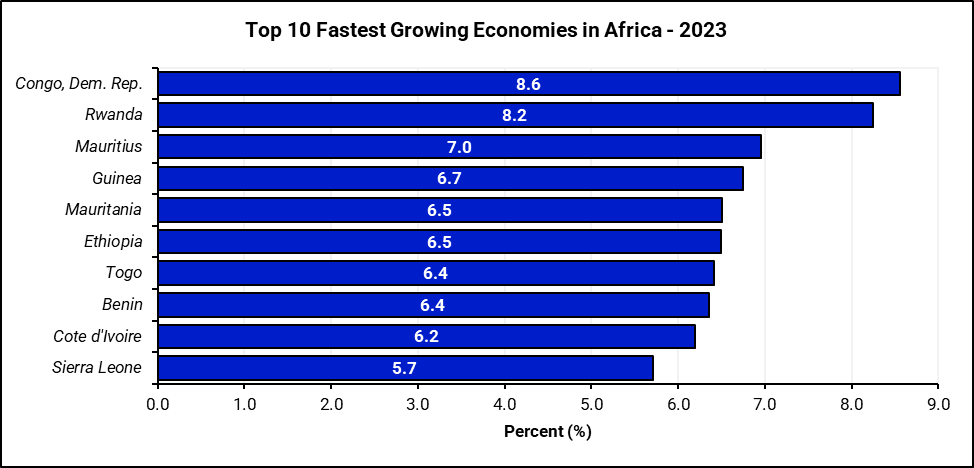
According to 2023 GDP growth figures, Rwanda ranks second among the fastest-growing countries in Africa and is likely to be even better with the current growth of 8.9% for 2024[2]MINECOFIN. 2024. Rwanda Registers 8.9% Growth, Confident in Economic Outlook. https://www.minecofin.gov.rw/news-detail/rwanda-registers-89-growth-confident-in-economic-outlook.
Today, Rwanda is no longer struggling for survival; it is striving for a middle-income status by 2035 and a high-income status by 2050. This economic turnaround is concrete proof of what hope, determination, and strong leadership can achieve.
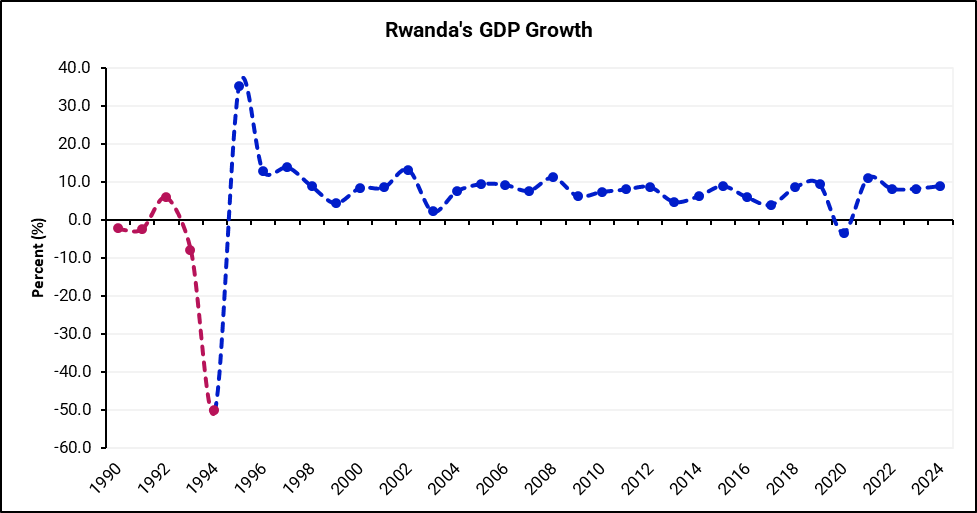
After 31 years, strategic policies prioritising human capital development, agricultural modernisation, and private sector growth seem to be relevant and on point, as Rwanda has achieved an exceptional recovery, recording growth above 7% in 22 out of 30 years, one of Africa’s most consistent growth performances.
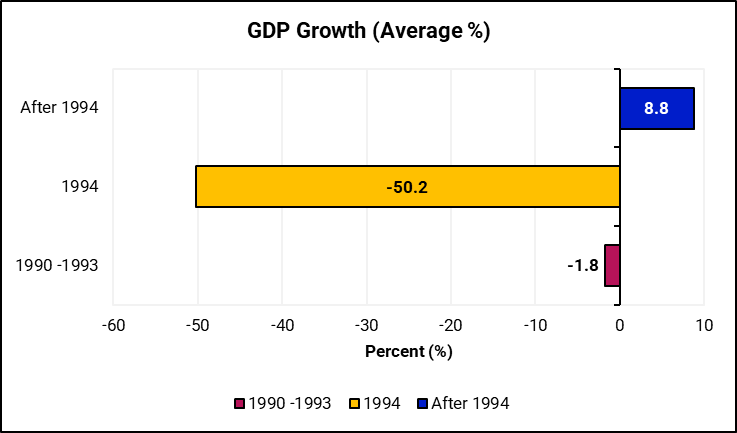
From figure (3), before 1994 (i.e., 1990-1993), GDP growth averaged 1.8% below zero, reflecting instability and inefficient use of resources. In 1994, it plunged to -50.2% due to the devastation of genocide against the Tutsi.
However, post-genocide recovery was remarkable, with an average growth of 8.8%, showcasing Rwanda’s resilient economic revival and sustained progress.
Rwanda shifted from survival mode to a bold vision of prosperity, leveraging the human capital as its most valuable asset. Through the human capital, the country unlocked faster productivity and production growth.
2. Life Expectancy: From Death to Renewed Life
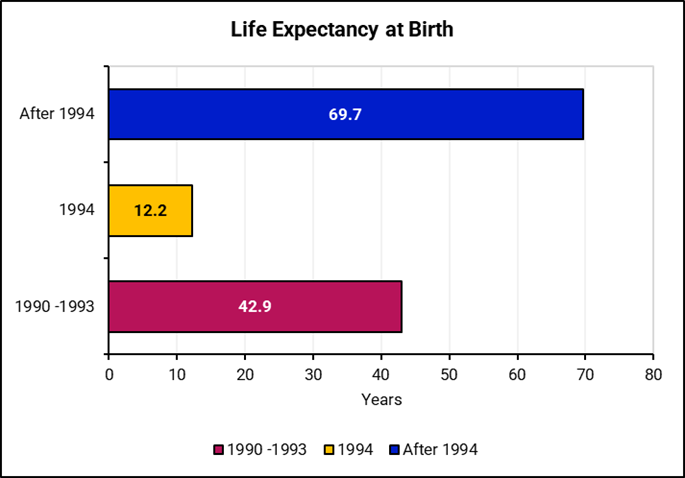
One of the perfect indicators to portray Rwanda’s journey from darkness to light as a Sign of Hope is the life expectancy. In the early 1990s, before the genocide, the average Rwandan lived just 42.9 years.
The 1994 genocide against the Tutsi pushed those years to as low as 12 years. But today, life expectancy has skyrocketed to 69 years. This reflects better healthcare, reduced child mortality, and a society that has moved from desperation to rebuilding.
Different crucial policies have effectively contributed to this possibility, including but not limited to universal health coverage, disease control, and improved nutrition, all of which have played a role.
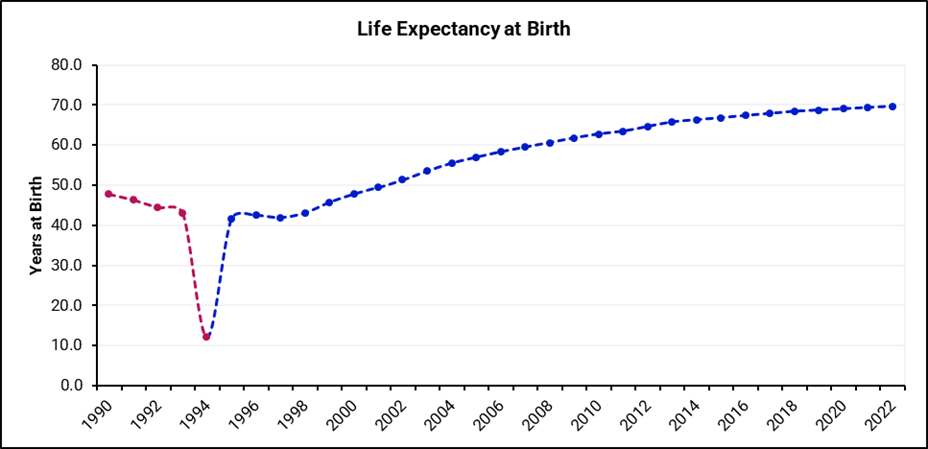
Rwanda pulled off a remarkable post-genocide recovery in life and improvement in life expectancy, reflecting the. In the early 1990s, before the genocide, Rwandans lived an average of 42.9 years, which was already far below global standards (64.2 years).
The 1994 genocide caused a devastating plunge in life expectancy to a mere 12.2 years due to the crumbling of the healthcare system and deaths.
Nevertheless, through the determined rebuilding of health systems and social services, Rwanda achieved a rapid historical health recovery to a life expectancy of 69.7 years in the post-genocide period.
Equally critical is the fight against child stunting, a legacy of past malnutrition. This is an important indicator because healthy, educated children mean a stronger workforce tomorrow.
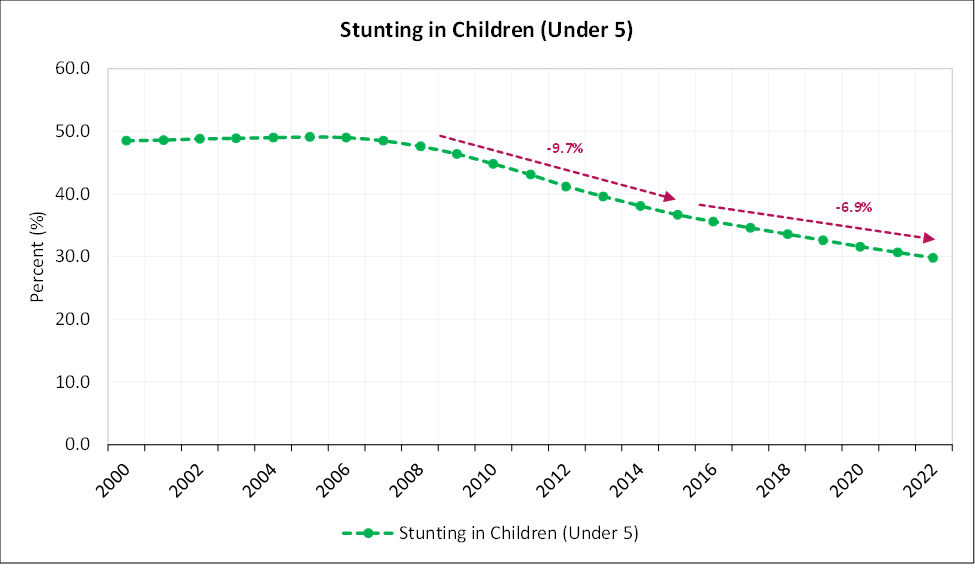
In 2000, nearly half of Rwandan children under five suffered from stunting. Today, that number has been cut by more than half, thanks to targeted nutrition programs and healthcare access.
Only within 14 years, between 2009 and 2022, stunting was cut by 16.6%, from about 46% to 29.8%. Under the National Strategy for Transformation, this value is expected to be cut by half to 15% in 2029.
3. Investing in the Future: Education and the Fight Against Stunting
Rwanda’s remarkable transformation in education reflects a shift in how the nation invests in its youth. The government’s focus on digital literacy and skills development ensures that the next generation is prepared for a modern economy.
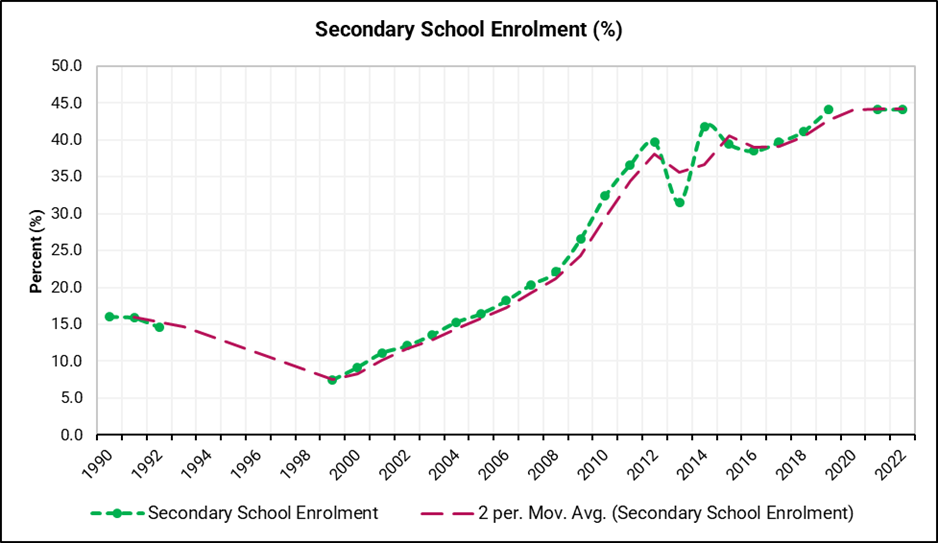
The proof of this can be seen easily in the chart below. The chart shows that in the pre-1994 period, enrolment stagnated below 20% from 1990 with a declining trend. Post-genocide enrolment climbed from only 7.5% in 1999 to 44.2% in 2022 as Rwanda completely transformed its education system.
This transformation was based on different aspects, including but not limited to curriculum reforms, gender parity policies, teacher training, and massive infrastructure investments, to name a few.
This approach completely opposes the doctrine of the pre-genocide period, where young people were intoxicated with discrimination and genocidal ideologies.
This confirms the nation’s effort to replace destructive ideologies that were fed to the young generation with constructive knowledge that is meant to build a prosperous nation.
Conclusion
There are thousands of indicators I can point out to voice the sensational positive transformation that has taken place in Rwanda since the 1994 genocide against the Tutsi.
There is evidence and signs that this is going to be even better in the coming days, inspired by good governance, innovation, and policies that promote development.
Indeed, Rwanda is proofthat hope can make light defeat darkness and make what seemed impossible to be possible.
References
| ↑1 | World Bank. 2024. Rwanda Country Economic Memorandum : Pathways to Sustainable and Inclusive Growth in Rwanda. Washington, D.C. : World Bank Group. |
|---|---|
| ↑2 | MINECOFIN. 2024. Rwanda Registers 8.9% Growth, Confident in Economic Outlook. https://www.minecofin.gov.rw/news-detail/rwanda-registers-89-growth-confident-in-economic-outlook |